Construction technology
U-Boot and Cobiax Voided Slabs: How They Work and Where Rebar Fits
How U-Boot and Cobiax two-way voided concrete slabs work, what the maker and trade press report, what to watch on site, and where rebar fits.
- Published:
- Updated:
- Reading time
- 3 min read
Contents
Searches in Iran for U-Boot and Cobiax slabs rose over the past week. Both names refer to two-way voided concrete slabs: floors in which part of the concrete that does little structural work is replaced by hollow plastic formers, cutting the slab's self-weight while keeping its two-way behaviour. This guide explains how the two systems work, what the U-Boot maker and a trade-press report say about them, what to watch on site and where reinforcement fits in.
What is a two-way voided slab?
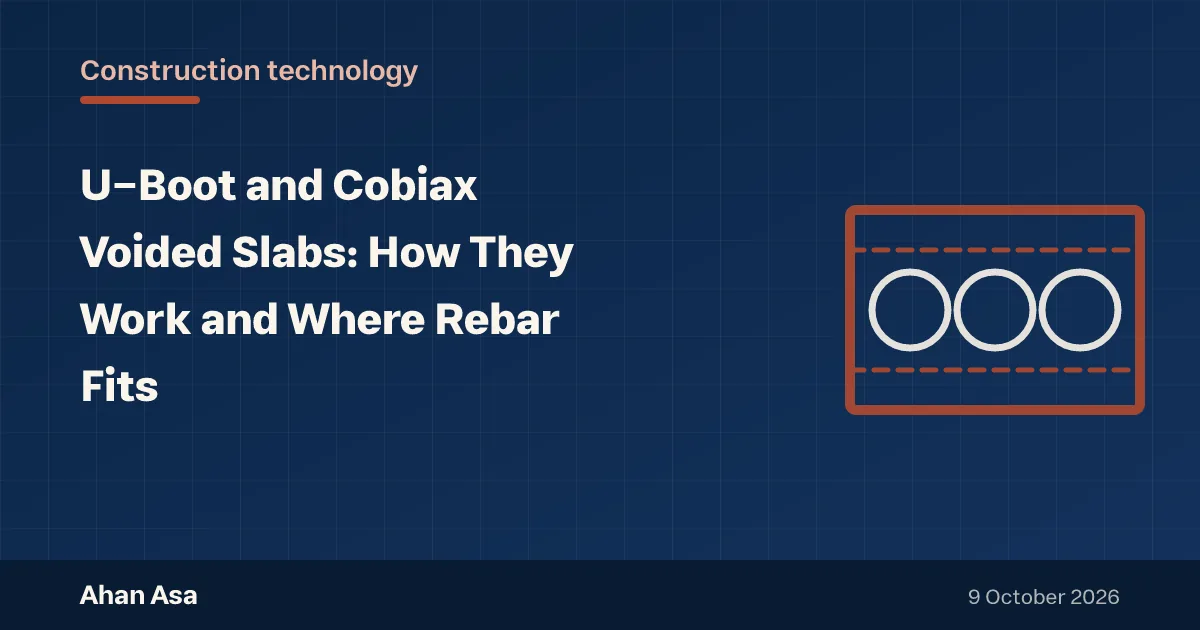
In a solid slab the full depth is filled with concrete, although not all of it contributes equally to carrying load. A voided slab places voids where they matter least. The result is a slab that is flat on top and underneath, with either a grid of perpendicular concrete ribs or regularly spaced hollow bodies inside.
How U-Boot works
According to its manufacturer, Daliform, U-Boot Beton is a permanent formwork made of recycled plastic for two-way voided slabs. Each element has a 52 × 52 cm base, with heights from 10 to 60 cm depending on configuration (single or double). Once cast, the slab has a continuous bottom plate and a continuous top plate joined by perpendicular ribs. The manufacturer lists these benefits:
- less concrete and steel in slabs, columns and foundations;
- larger open spaces with fewer architectural constraints;
- thinner slabs for the same loads and clear heights, or more floors within the same building height;
- a seismic advantage from lower building weight.
Daliform also states that the voids are placed in zones where shear demand is low.
How Cobiax works
Cobiax fixes hollow bubbles made of recycled plastic into modules made of reinforcing steel. In a 2019 report, Construction Management wrote that these units replace up to 35% of the reinforced concrete required in slabs. The same report describes a mixed-use scheme in Mannheim, Germany, where the project team said the system had saved 1,613 tonnes of concrete by the time the shell of its 13-storey tower was complete. That figure belongs to that project and should not be generalised.
Where rebar fits
A voided slab is still a reinforced concrete slab:
- Bottom and top meshes: in Daliform's installation sequence, the bottom bars go down first in two perpendicular directions, then the formers, then the top bars, so the formers sit between the two meshes.
- Shear and punching reinforcement is added where the design requires it, according to Daliform.
- Solid zones around high-shear areas are detailed by the structural engineer.
The grade, for example A3 (Aj400) rebar or A4 (Aj500) rebar, and the bar sizes and spacing come from the structural drawings. To estimate mesh weights, see our rebar weight tables.
Site considerations
- Flotation: Daliform specifies a two-stage pour to stop the formers floating: a first layer up to the height of the former feet, then the rest of the slab once that layer has started to set. In the Mannheim project, according to the Construction Management report, a first layer of concrete was placed to bind the modules before the rest of the slab was cast. Follow the manufacturer's method and the supervising engineer.
- Design from the start: a voided slab cannot simply replace a solid slab on the same drawings; it has to be designed for the system.
- Pour quality: full compaction between and under the formers is essential for the ribs and bottom plate.
- Coordinated supply: formers, rebar and concrete should arrive on one schedule so that materials are not left exposed on site.
Summary
U-Boot and Cobiax are two ways to lighten two-way concrete slabs: box formers that create ribs, or hollow bubbles held in steel modules. Both cut the slab's self-weight by removing concrete, but the saving is set by each project's design. For rebar supply against your bar schedule, browse our rebar range or contact us.
Frequently asked questions
What is the difference between U-Boot and Cobiax?
Both form voids inside a concrete slab with recycled plastic formers. U-Boot uses square-based boxes that create a grid of perpendicular ribs; Cobiax uses hollow plastic bubbles fixed into modules made of reinforcing steel.
Does a voided slab use less reinforcement?
The U-Boot manufacturer states that the lighter slab helps reduce concrete and steel in slabs, columns and foundations. The actual quantity depends on each project's structural design.
Which projects suit voided slabs?
The U-Boot manufacturer presents its system for beamless flat slabs with large spans or heavy loads, and for foundation rafts. The choice belongs to the structural engineer.
Sources
- U-Boot Beton void box for two-way lightened slabs — Daliform Group
- Plastic bubbles remove 1,600 tonnes out of tower — Construction Management (CIOB), 2019-10-26
By Ahan Asa Editorial Team